
 Give a Gift
 Previous
Read by Michael Flamel
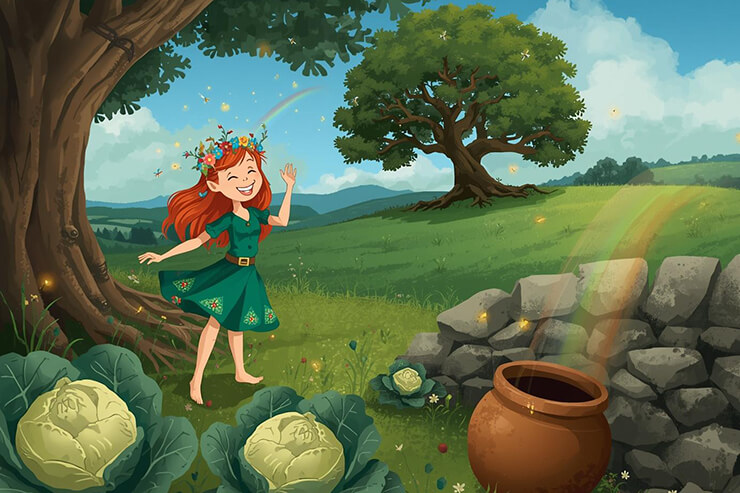
If you ask the hills of Kerry for a love story, they point to the old oak that leans toward the O’Malley place and say, “Start there.” The wind keeps a memory or two in its pockets, and on certain evenings—when the sheep are full of opinion and the clover smells like tea—you can hear the tale of Siobhan O’Shillelagh and Liam O’Malley told in the hush between birdsong and dusk.
Siobhan was a leprechaun of the more troublesome sort: quick as a wren, freckled as a trout, and equipped with a laugh that made banshees feel upstaged. She kept a tidy pot of gold the way a bird keeps a feather—more out of habit than need—and wore her magic lightly, like a shawl you don’t notice until the rain begins. She loved riddles, red currants, and the way soil warms a seed if you kindly hum to it.
Liam farmed the neighboring fields, a man with hands that knew every knuckle of the land. He coaxed carrots from clay, remembered the names of the old cows, and thanked his tools each evening the way some folks say grace. He had been, in the way of farmers, married to weather and patience for years. Yet, even the patient grow curious when the wind starts whispering change.
They met on a morning stitched of mist and sun. Siobhan stepped from a curl of foxglove shade as if she’d been hiding behind the day itself, hair like a lit match and boots mud-to-the-ankles.
“Top o’ the morning,” she said, as if greeting a conspirator. “Your potatoes look peaky.”
“They’re only thinking,” Liam replied. “As do some men before breakfast.”
“Let’s wake them.” She tapped her heel twice and made a small spiral with her finger. In reply, the potato tops plumped, then—well, it’s rude to stare, but it isn’t every day you see tubers fatten like a chorus inhaling before the big note.
Liam took off his cap. “What do I owe you for that, miss?”
“A proper hello,” she said, and stuck out her hand.
They shook, and something ran up from the ground and down from the sky and threaded itself gently through both of them, tying their mornings together.
After that, Siobhan came by when the dew still thought itself in charge. She showed him how to sing to cabbages in the key of C (for crisp), and he taught her which stone to sit upon if you wanted the hayfield’s breeze to braid your hair. They traded knowledge: she gave him small magics, and he gave her bigger ones—how to mend a fence so a ewe feels respected; how to listen for rain hiding in a far hedgerow; how to hold still long enough that a robin thinks your thumb is a branch.
Now, mischief is a crop that grows best when unattended. One afternoon, with Liam gone to borrow a harrow, Siobhan decided to improve the humor of Old Seamus next door—a man whose grin had rusted since the last good fiddle tune. She dusted his henhouse with a pinch of rainbow to encourage “eggs of more robust temperament.”
The hens obliged with enthusiasm bordering on hysteria. They produced eggs round as cannonballs and narrow as flutes; eggs speckled, striped, and one that appeared to be tartan. A hen named Bridget laid something the size of a respectable pumpkin and fainted softly upon it.
By the time Liam jogged over, feathers were confetti and Seamus was practicing new swear words with a lilt. Siobhan, mortified, was trying to cradle six mismatched eggs in two repentant hands.
“I only meant cheer,” she murmured.
“Then we’ll tidy first and cheer after,” Liam said. He set to work right beside her, gentle with the hens and kinder with Seamus. Together they sorted, soothed, and stabilized Bridget with a saucer of buttermilk and a lullaby. By dusk, there were baskets of perfectly good marvels and a farmer whose frown had loosened enough to let out a chuckle.
When they left, Seamus pressed a small striped egg on them. “For your breakfast,” he said, “and your sins.” His eyes were brighter. “But if it hatches into a zebra, I’m sending him over to plow.”
As Summer bruised into Autumn, magic and muscle worked shoulder to shoulder on the O’Malley farm. Liam’s rows were always neat, but now they felt glad. The soil listened. The carrots came up with a carillon of tiny bells, and the pumpkins swelled like moons practicing full. Word traveled the way it does in small places: on bread, in church, through a hedge. Visitors came to admire and left with a handful of wonder and a recipe for colcannon.
What surprised the pair most wasn’t the yield, but the quiet they found inside it—the way labor arms around love and calls it by its first name. They cooked what they grew; they grew because they cooked. After supper, they walked the fenceline and counted constellations at eye level: fireflies.
“Siobhan,” Liam said once as they watched the sheep arrange themselves into an opinionated cloud, “I know what you are.”
“And?” she asked, trying brave but managing only bravish.
“And I’m grateful,” he said. “For the potatoes. For the hens. For that laugh that makes rain reconsider.”
She exhaled, all the way down to her toes. “I’ve a pot of gold,” she confessed, “but it’s a terrible investor. Keeps wanting to spend itself on mornings like this.”
He tapped his chest. “Mine, too.”
The fair folk, who track their own with a vigilance matched only by the local crows, began to make visits. They came like rips in the light, like songs before words. They teased Siobhan for the dirt crescents that had taken up residence beneath her nails. They admired the man who could hear a seed thinking. They were not sure, however, about the math of mortality.
“Little sister,” said one with hair like found wheat. “Are you certain of this bargain? Eternity is a long time to misplace.”
Siobhan glanced toward the garden where Liam knelt, sleeve rolled, wrist gentle around a loosened onion. “I’ve had eternity,” she said. “I’m trying now.”
“Now rusts,” the fairy warned.
“So do plows,” Siobhan agreed. “That’s what oil is for. And friends. And soup.”
The fairies conferred in a shimmer. They gifted her a woven ribbon of starlight that would keep away the kind of sorrow that sours milk and blights apples. It would not spare her ordinary grief—nothing true ever does—but it would help the house remember laughter on long nights. Then, in a flurry of moth wings and opinions, they left her to the harvest she had chosen.
The village decided that a love like this should be properly scandalous, which is to say celebrated. They twined the square with hops and holly, pushed tables together until time itself would have to take a seat, and called Father Declan to officiate on the understanding that he not scowl at cabbages during the vows. He agreed, though he did request that the pumpkins remain outside for structural reasons.
Siobhan wore a dress the color of a hedge at noon and a crown of whatever grew within reach when she closed her eyes. Liam wore his best shirt and the look of a man who has already memorized the next 50 years of a face. Seamus arrived with a basket of regulation-sized eggs and the tartan one on a cushion like a local duke.
They pledged what the wise always pledge: enough. To weed without counting who started the row; to keep a warm plate and the porch light; to argue in a tone that remembers tomorrow morning’s chores will require both sets of hands. Father Declan blessed them with water that had known a hillside and bread that had known a fire. When the kiss landed, every bell that could ring within five miles did so, including, uncannily, a frying pan.
After the feasting came the dancing, and after the dancing came the walking home under a sky so starry it looked porous. They paused beneath the old oak. Fireflies rose, lanterns of a procession that nobody had to lead.
“Listen,” Siobhan said. “The night is planting itself.”
“And we’ll be here to weed it come morning,” Liam answered. They did, and also the next morning, and a great many after that, which is how a marriage is made.
There is a part of the story we must tell carefully, because it rained while it happened and made everything feel slippery. Some months after the wedding, the fair folk returned with a formal proposition, embossed with moonlight and a certain tone.
“We have discovered,” said the wheat-haired one, “a way to unspool your vow, should you wish it. Come back with us; keep your shine. Your days will be long as the road to Skibbereen when the tide’s out.”
Siobhan considered the offer with a seriousness usually reserved for knives and new neighbors. Her immortality—the old one—had been airy and unthreatened. The new days came with splinters, weather, a husband who snored when overtired, and onions that bolted if you turned your back. They also came with mornings that required you to choose them, which is the only kind worth having.
“What does forever mean,” she asked, “if you never have to hurry to hold a hand?”
The fair folk argued that art and music and mischief require witnesses who persist. Liam, hearing none of this but sensing its outline, wiped his boots and came to stand beside his wife.
“I can’t tell you what to do,” he said, not touching her except with his voice. “I can only tell you who I will be tomorrow, and the day after, if you wish it: the man next to you in the row.”
The rain softened. The oak gave a leaf from a high branch—a small, green amen.
Siobhan chose, as most of us must, with her whole self. “I will keep the kind of forever that fits in a day,” she said. The ribbon of starlight warmed on her wrist. The fairies—who dislike crying in public—nodded briskly and vanished with a sound like seed poured from a sack.
There are chapters you expect next: the building of a life, which in this case included a cousin named Mary who arrived in city shoes and left in overalls, having discovered that muck is a great equalizer; the expansion of the farmhouse by stages, each addition pretending not to be wonky; a midwinter illness that tested the ribbon and found it faithful; the first lamb born on a night when the moon wore a cloud like a shawl. There was sorrow, properly portioned, and pleasure taken with both hands.
One Summer night—the kind with gold still stuck to it from earlier—Siobhan and Liam danced barefoot in the meadow until their breath laughed them down into the grass. They watched stars find their places as if someone had whistled them home.
“It’s moments like this,” Liam said into the sky, “that make work seem like a way to reach them.”
“Work is spellcraft,” Siobhan answered. “Add water, wait, and be astonished.”
They kept astonishing. The pumpkins never again required cartographic maps, but they were generous. The hens returned to a sensible schedule, though Bridget maintained an artistic temperament and a fondness for lullabies. Seamus smiled more often, claiming it made the weather less cheeky. Mary discovered she preferred the company of goats to most committees and assumed a happiness that bewildered her city friends.
Years did their fine work. A pot of gold waited patiently by the stone wall, holding down a rainbow like a paperweight on a window bill. Sometimes the grandchildren—there were eventually enough to be noisy—played near it, filling it with buttercups while the actual coins napped underneath like respectable turtles. When a child asked what was inside, the adults said, “Breakfast money and secrets,” which is both correct and safe.
On the day the oldest grandchild learned to tell the weather by the taste of the breeze, Liam and Siobhan returned to the oak with a thermos of tea and a heel of soda bread. They sat in the benevolent shade and counted, not crops or coins, but keeps: a roof that had heard their quarrels and kept their sleep anyway; a gate that clicked shut because someone always remembered to do it; the particular way Siobhan’s laughter had grown roots and could be found even on days it forgot itself.
“Would you change anything?” Liam asked, eyes gone soft with the kind of tired that comes from living fully.
“I might have started singing to cabbages sooner,” she said. “And been gentler with that first hen.”
“Bridget forgave you,” he said. “Eventually.”
The afternoon went on being exactly itself. When the youngest grandchild toddled over with a buttercup, Siobhan tucked it behind the child’s ear and felt the old ribbon warm again, as if gratitude itself were a species of heat.
The hills, being hills, composed the final paragraph without consulting anyone. It goes like this:
Love is not a trick, a prize, or a pot to be stumbled upon at the end of a rainbow. It is a field you choose and choose again, a row you weed while the sky thinks about rain. It is a hand extended during a hen catastrophe, a vow made of ordinary promises, and a laugh that persuades a hard day to soften by an inch. It is mortal as bread and as necessary. If you do it right, it glows a little at the edges.
And if you ever walk past the O’Malley place at evening, you may see two figures by the oak—one tall, one quick—and the air between them humming the way soil does when roots are busy. You may think, ah, so this is where the magic is kept. You’d be right, though not in the way you first suppose.
The rest is simple: they lived, they worked, they feasted, they mended, they mourned, they celebrated, and they taught the next small hands which stones make the best seats for hair-braiding breezes. When they were very old, they still turned toward each other like sunflowers at dusk.
As for the pot by the wall: some evenings it shines. But mostly it holds daisies and lost buttons, which is just the sort of wealth a sensible household requires.
And that is the story the hills keep—the one the wind carries from clover to kitchen to cradle—about the lady leprechaun who traded a rainbow for roots, and the farmer who sowed his life in good faith and harvested joy. If you listen closely, you can hear them laughing still, as the fireflies lift from the grass and the cabbages hum themselves to sleep. ❖