

 Give a Gift
 Previous
Read by Michael Flamel
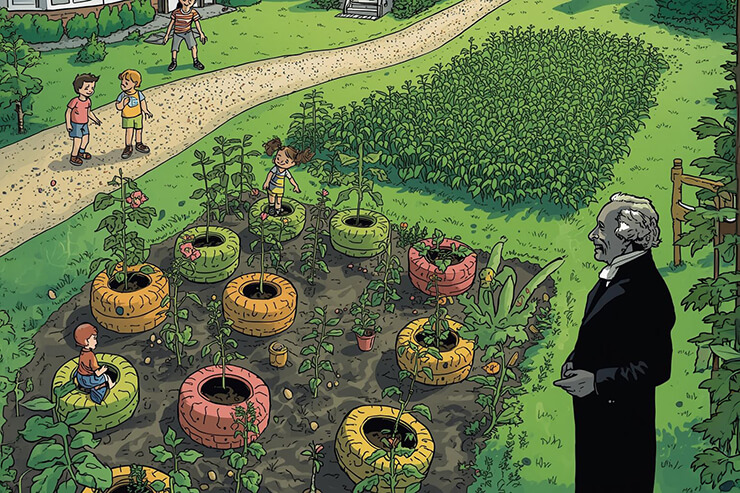
When I was in third grade, my teacher, Mrs. Groh, handed me a copy of Carver’s George, the inspiring landmark story of George Washington Carver. Little did I know it would plant the seed for a lifelong fascination with one of the most brilliant agricultural scientists in American history—and eventually lead me to grow what became, quite possibly, the biggest soybean farm inside city limits.
I devoured every Carver story I could find, visited his boyhood home near Neosho, Missouri, and made several pilgrimages to Tuskegee Institute in Alabama. Born to enslaved parents just after the Emancipation Proclamation, George Washington Carver overcame staggering odds to become a pioneering scientist and professor at Tuskegee. He taught poor farmers, black and white alike, how to revitalize Southern fields depleted by years of cotton cultivation. By planting nitrogen-fixing legumes like peanuts and soybeans, farmers could restore their soil’s health without expensive fertilizers.
Carver’s genius didn’t stop there. When farmers flooded the market with peanuts, he developed over 300 uses for them, from peanut butter to linoleum. He even turned down lucrative offers from the likes of Henry Ford and Thomas Edison, choosing instead to continue his service at Tuskegee.
Inspired by his creativity and resourcefulness, I’ve shared Carver’s story with countless children and adults. I’ve even developed what I call The Principle of Carverativity, a simple but powerful idea: If Dr. Carver could find 300 uses for peanuts, we can find creative ways to reuse what others call junk—and inspire kids to discover the joy of gardening in the process.
For example, we’ve turned old tires into planters and hosted the Old Tire Holympics, transforming discarded wheels into games. Empty detergent bottles become squirt guns for endless fun, without any concerns about mimicking violence. After all, as Carver wisely said, “You murder a child if you tell him or her to keep out of the dirt. In dirt, there is life.”
My Soybean Journey
After serving as an Army medic in Vietnam, I returned home and ran a resident camp near Minneapolis. Gardening became one of our activities alongside swimming and archery, and it wasn’t long before I started a children’s garden. When my family settled into a farmhouse in Mound, I faced a new challenge: a long, unsightly gravel driveway.
Inspired by Carver’s teachings, I decided to plant soybeans to reclaim the space. Without the funds for a gas-powered rototiller—or the desire to contribute to pollution—I tackled the compacted gravel by hand. Each day, I shoveled, wheelbarrowed, and enriched the soil with naturally composted dirt from the surrounding woods. Slowly but surely, the soybeans took root, nourished the soil, and transformed our barren driveway into a lush green garden.
Within two years, I had cultivated what we proudly called The Biggest Soybean Farm Inside the City Limits of Mound. The next challenge? Finding 300 fun ways to prepare soybeans—a task that still keeps me busy to this day.
A Legacy Worth Sharing
George Washington Carver’s legacy continues to inspire gardeners, farmers, and educators like me. His life’s work reminds us to be resourceful, to nurture the land, and to encourage children to get their hands dirty. After all, in dirt, there is not only life—there’s a world of possibility. ❖
About the Author: Larry Johnson weeds the Old Gardening Party (OGP) to keep the world safe for children, gardening, and storytelling. He has always had a garden, including one by the gasthaus near the base where he served as an Army medic in Germany. He and Tyler the Earthworm had a garden on the roof of Children’s Minnesota-Minneapolis Hospital where they started the first participatory pediatric TV channel for patients. Larry started school gardens and taught storytelling and video in the Minneapolis schools. He is author of “SIXTY-ONE” and has helped Oscar Wilde’s “Selfish Giant” share his garden with the children in many places around the world.




Great read ! I remember reading about “The Peanut Man” in school. But, our teacher never went into depth about how he got started…. or all the things he did. It was more like just one more fact to remember for the test on Friday. It wasn’t until the 1970’s that I got really interested in organic gardening. It changed my life completely. You can’t grow good food with out good soil.