

 Give a Gift
 Previous
Read by Michael Flamel
I’ve long celebrated Groundhog Day on February 2, not because I rely on a furry rodent to predict the weather, but because it marks the midway point between Winter’s longest nights and the glorious season of Spring planting. However, my enthusiasm for groundhogs has been tested—especially when one particularly bold garden thief made himself at home in my vegetable patch.
Now, I don’t like to admit this publicly, but in moments of frustration, I have imagined a certain groundhog lying on a platter, an apple tucked into its mouth, like the guest of honor at an old-fashioned feast. But instead of medieval fantasies, I settled for a more diplomatic approach—natural deterrents like ageratum and lavender, both rumored to send groundhogs packing. Unfortunately, our uninvited guest had a refined palate and simply dined around the fragrant obstacles.
Desperate, we launched The Great Groundhog Relocation Program with an official city-issued live trap. We were determined to outwit our whiskered nemesis, but all we managed was a raccoon—a particularly irate one who preferred garbage-can dining over fresh produce. In his frustration, he dragged the trap across the lawn, plowing what could generously be described as a “modern art” garden design. Meanwhile, our groundhog remained at large, thumbing his nose at our efforts.
Our neighbor, who had no garden of his own, took a different view. “I like him,” he said. “He eats my dandelions.”
And so, as if responding to an open invitation, the groundhog packed his bags (metaphorically speaking) and sauntered next door—where he was, at last, appreciated.
A Groundhog with Expensive Taste
A few years later, I started a children’s garden in a neighborhood near the Mississippi River in Minneapolis. Most of the kids had never planted a garden, and they loved watching our local groundhog lumber around like a sleepy landlord inspecting his property. Their admiration, however, wavered when they realized he wasn’t just visiting—he was feasting.
We tried various solutions, from fencing to companion planting, but nothing deterred our rotund resident. Inspired by folktales like “The Peasant and the Bear” and “Tops and Bottoms” by Janet Stevens, we decided to fight trickery with trickery. And so, we created our own story.
The Kids and the Greedy Groundhog
A Tale of Clever Gardeners
One Spring morning, Tommy and Lisa were planting their garden when the groundhog waddled up and announced, “I want everything you grow.”
The children, startled by his talking though not entirely surprised (This was their story, after all.) quickly recovered.
“That doesn’t seem fair,” Lisa said, crossing her arms. “How about this? We’ll take everything that grows underground, and you can have what’s on top.”
The groundhog, perhaps flattered by their lack of protest, muttered, “Oh, I guess that’s fine.”
So, Tommy and Lisa planted radishes, carrots, potatoes, and beets. When harvest time came, they pulled up their beautiful root vegetables and generously offered the groundhog the leaves and stems.
Realizing he’d been tricked, the groundhog huffed and grumbled, “Next year, I get what’s below, and you get what’s on top.”
Tommy and Lisa grinned. “Deal.”
The next season, they planted corn, tomatoes, and squash. At harvest, they picked every delicious morsel growing above ground, leaving the groundhog with a feast of roots and vines.
Now fuming, the groundhog stomped his paw. “Fine! Next year, I get everything—above and below!”
Tommy and Lisa simply nodded, already hatching their next plan.
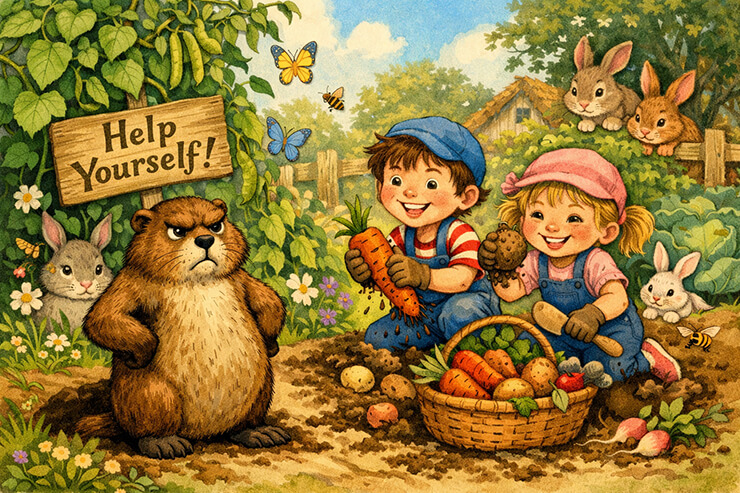
That Spring, they planted nothing but beans. The vines flourished all Summer, producing an endless bounty. But by harvest time, the plants had stopped bearing, and the children posted a sign:
“Haven’t touched the garden since we left for the family cabin weeks ago. Help yourself!”
Realizing he’d been outwitted yet again, the groundhog threw up his paws. “I give up!”
And from that day forward, he never touched Tommy and Lisa’s garden again.
Moral of the story?
Sometimes, when nature doesn’t cooperate, a little creative thinking goes a long way. ❖
About the Author: Larry Johnson weeds the Old Gardening Party (the OGP) to keep the world safe for children, gardening, and storytelling. He has always had a garden, including one by the gasthaus near the base where he served as an Army medic in Germany. He and Tyler the Earthworm had a garden on the roof of Children’s Minnesota-Minneapolis Hospital where they started the first participatory pediatric TV channel for patients. Larry started school gardens and taught storytelling and video in the Minneapolis schools. He is author of “SIXTY-ONE” and has helped Oscar Wilde’s “Selfish Giant” share his garden with the children in many places around the world.