
 Give a Gift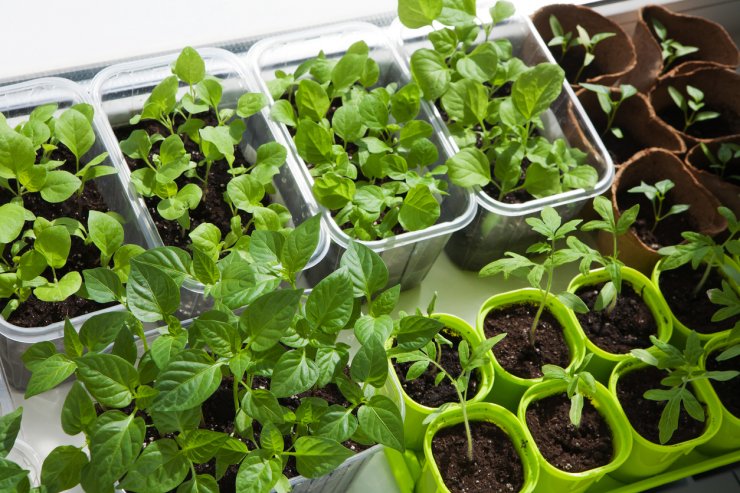
Indoor garden
If you’ve seen one soil, you’ve seen them all. It’s just dirt, right? Is there any reason you can’t use your raised bed soil for your indoor garden? The answer is not complicated, but there’s a little more to it than just “yes,” or “no.” The best soil for an indoor vegetable garden may not be soil at all. We’ll get to that in a minute.
Plus, there are some limitations. It’s unlikely that you’ll ever be able to grow corn indoors, no matter what kind of soil you use. On the opposite end of the spectrum, I’m pretty sure mint will grow no matter what. I’d bet good money that you could throw it into a dark corner of your basement and it would thrive.
There are also non-soil methods for growing indoor gardens, like hydroponic gardening. Not to mention the fact that different plants require different nutrients. So where does that leave us?
Discover 7 top tips for growing, harvesting, and enjoying tomatoes from your home garden—when you access the FREE guide The Best Way to Grow Tomatoes, right now!
What is the best soil for an indoor vegetable garden?
Let’s start with actual soil, then we’ll get into hydroponic solutions. To be blunt, poor soil will ruin your gardening experience. Your soil may not have the nutrients your plants need, it could be contaminated with mold, fungus, or tiny pests, or it could be too dense, meaning the plant roots can’t get the oxygen they need. In other words, to get the best soil for an indoor vegetable garden, you gotta start fresh.
When you buy soil, or make your own, remember that an indoor garden is a container garden. That means you’ll need soil that will retain moisture and drain easily. Additionally, you’ll want a nutrient-rich soil, since your indoor garden won’t get the benefits of decaying leaves or worm castings unless you add that in.
Now, just to make things complicated, when you start looking for the best soil for an indoor vegetable garden, you’ll find potting soil and potting mix. Potting soil is actual dirt, most likely mixed with other mediums and nutrients, but it tends to be more dense than potting mix.
Potting mix, on the other hand, is usually a soil-less mix consisting of some variation of peat moss, perlite, coco coir (from coconut husks), bark, and fertilizer. Incidentally, while peat moss is great for maintaining moisture, the process of obtaining peat moss is not usually environmentally friendly. Peat moss comes from peat bogs, which are noted for both their biological diversity, and for holding large amounts of carbon dioxide, which gets released as the peat moss is extracted.
That said, I’ve used a few different indoor potting mixes, and the best results I’ve had came from a blend of my own compost along with Coast of Maine Organic Grower’s Mix. I’ll admit I may be a bit biased, since this is a local-ish company for me. But I also love the fact that they source as much locally as they can, their products are listed by either the Organic Materials Review Institute (OMRI), Maine Organic Farmers and Gardeners Association (MOFGA), or the USDA National Organic Program as suitable for organic gardening, and they sell exclusively to smaller gardening stores.
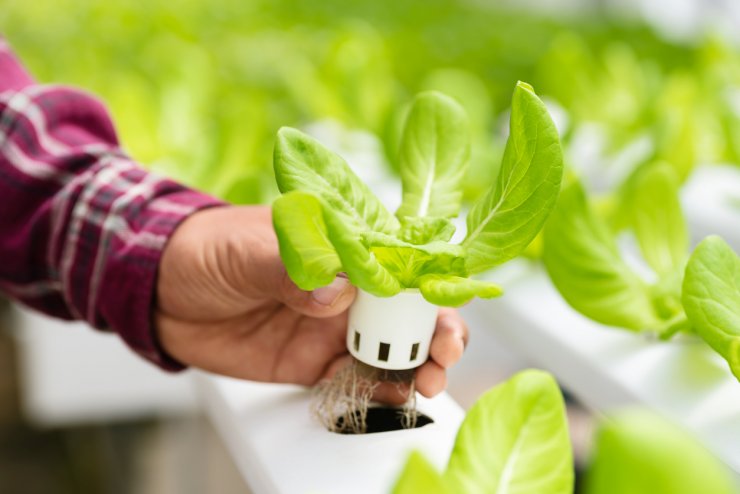
Hydroponic lettuce in net cup
The best soil for an indoor vegetable garden – when you aren’t using soil
The interesting thing about hydroponic growing mediums is that they are just there to support the plants. Unlike soil or potting mixes, these mediums don’t contain the nutrients your plants need. They’re more of a support system for plants and roots.
There is little consensus on what makes one medium better than another. In fact, because there are multiple hydroponic systems, there isn’t really a “best” medium. You may find anything from clay pellets to river rocks in a hydroponic system. Perhaps the most popular medium is rockwool. It is quite literally rock that is melted down and spun into fibers. There are some mixed opinions out there about rockwool, but for the most part, it’s free of pathogens, and it drains water quickly while retaining enough moisture to keep your plants hydrated.
Ultimately, whether you go with an indoor potted garden or a hydroponic system, the soil or growing medium you use can play a big role in your success. But don’t forget that light and water and care are important, too. It’s really the combination of everything that will give you the results you want.
What is your favorite soil mix for indoor gardening? I’d love to hear about your experiences in the comments section.
Discover 7 top tips for growing, harvesting, and enjoying tomatoes from your home garden—when you access the FREE guide The Best Way to Grow Tomatoes, right now!




wanting to find out about reuseing potting soil