

 Give a Gift
 Previous
Read by Michael Flamel
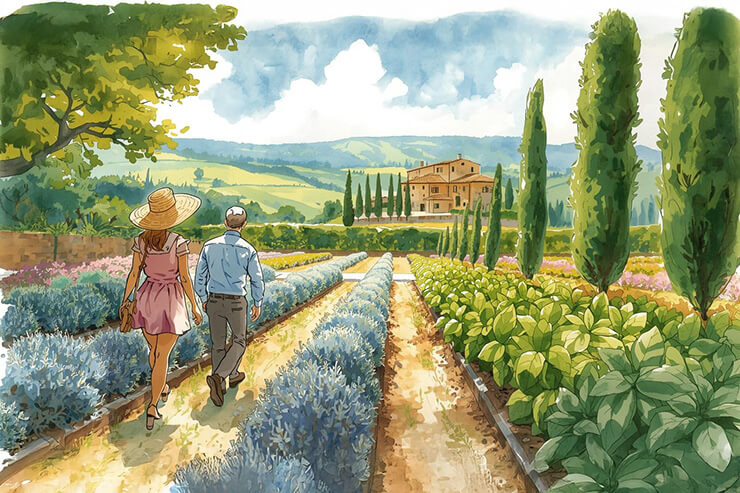
When Gail and I arrived at Alexandro’s farm in the rolling hills of Tuscany, we were greeted not by a basket of wine or a wheel of cheese, but by a bouquet of herbs so fragrant it felt as if the entire countryside had leaned in to say “Benvenuti!”
Alexandro, our cheerful farmer-guide with sun-creased eyes and a straw hat perched at an impossible angle, invited us to follow him down the narrow path between rows of lavender and rosemary. “This,” he declared in a lyrical Tuscan accent, “is the heart of our cucina. Without these herbs, we are only cooking. With them—we are telling the story of Tuscany.”
The Herb Walk with Alexandro
Rosemary – “Rosmarino” the Evergreen Romantic
Alexandro bent a sprig and invited us to inhale. “For roast meats, potatoes, even bread dough,” he said. Fun fact: rosemary’s Latin name means dew of the sea because it thrives along the Mediterranean coast.
- Grow it at home: Rosemary loves full sun and well-drained soil. In colder U.S. zones, keep it in a pot you can bring indoors for Winter.
- Tastes of Tuscany: Use it to season focaccia or to perfume roasted root vegetables.
Basil – The Sweet Summer Prince
“This one,” Alexandro said, “is for the soul of our sauces and every Summer salad.” Italians believe basil symbolizes love and hospitality.
- Fun fact: There are over 60 varieties, but sweet Genovese basil reigns supreme for pesto.
- Grow it at home: Plant after the last frost in a sunny spot or in an indoor hydroponic garden to keep the harvest going all year.
- Tastes of Tuscany: Pair it with ripe tomatoes, fresh mozzarella, and a drizzle of olive oil.
Oregano – The Bold Village Voice
Alexandro laughed, calling oregano “the herb that shouts ‘Pizza!’ across the valley.”
- Fun fact: Oregano’s aromatic oils are stronger when the plant grows in rocky, dry soil—an excuse not to pamper it.
- Grow it at home: Perfect for raised beds or pots, especially in Zones 5-10. Cut often to keep it bushy.
- Tastes of Tuscany: Sprinkle it over grilled vegetables or slow-simmered tomato sauce.
Thyme – The Quiet Keeper of Tradition
Tiny leaves, mighty flavor. “Thyme,” Alexandro whispered, “makes beans and stews sing without stealing the melody.”
- Fun fact: Ancient Romans burned thyme in homes to purify the air.
- Grow it at home: Thrives in sunny, sandy soils; drought-tolerant and Winter-hardy in many zones.
- Tastes of Tuscany: Add to white bean soup or roasted chicken.
Sage – The Wise Old Friend
Velvety leaves and a peppery-pine scent: sage is the star of the classic Tuscan dish Saltimbocca alla Romana.
- Fun fact: Medieval herbalists believed sage granted longevity—thus the saying, “Why should a man die in whose garden sage grows?”
- Grow it at home: Hardy perennial in Zones 4-9; loves sun and dislikes wet feet.
- Tastes of Tuscany: Brown in butter for gnocchi or toss with squash ravioli.
Bringing Tuscany Home
Alexandro’s parting words to us as we left the herb beds still echo: “You don’t need the Tuscan hills, only the Tuscan herbs.”
A sunny balcony, a raised bed, or a set of pots on a kitchen windowsill can turn any American home garden into a little piece of Italy. Start with basil and rosemary for summer dishes, then branch out to oregano, thyme, and sage to deepen your flavor palette. And don’t forget a drizzle of good olive oil to finish the story.
Join the Conversation
We’d love to hear from you! What’s your favorite Italian herb, and how do you use it in your cooking—on pasta, grilled vegetables, homemade bread, or something unexpected? Share your culinary herb stories in the comments below, and let’s keep the flavors of Tuscany growing all across America. ❖