
 Give a Gift
 Previous
Read by Michael Flamel
In the quiet corner of my backyard in Westport, Connecticut, sits a humble compost heap—my ever-evolving monument to patience, decay, and renewal. Framed by upright logs and wrapped in garden fencing, this pile has become more than just a source of nutrient-rich soil. It’s my meditation mat, my science experiment, my slow-spinning carousel of life.
Composting, for me, is part spiritual practice and part backyard sport. It anchors my garden and my days, churning out the dark, fertile humus that turns a patch of suburban soil into a green, growing oasis for half the year. But beyond its utility, the pile has grown into a quiet teacher, connecting me to some of the biggest challenges of our time: food waste, climate change, biodiversity loss, and the industrial unraveling of healthy soil.
I’ll admit it—I spend more time tending the compost than I do the actual vegetables. And I’m not alone. Composters everywhere are quietly joining a movement rooted in ancient wisdom and modern urgency.
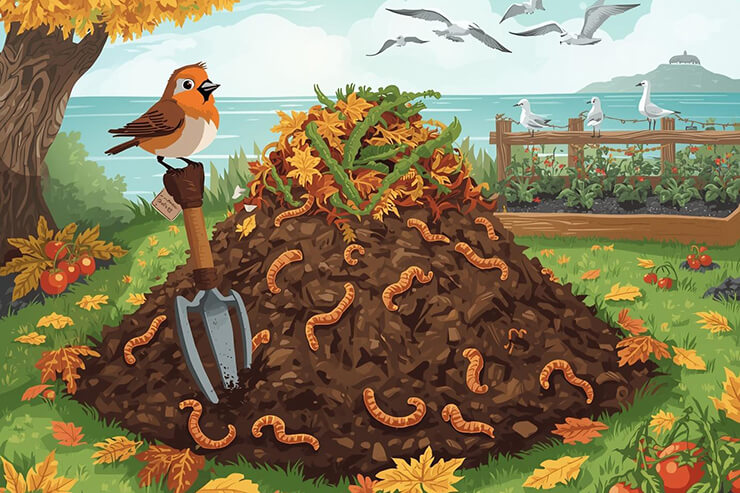
The bones of my setup are what’s called a “log cabin” heap: two ascending rows of upright logs spaced 8-feet apart, with garden fencing stretched between the rear posts. In Autumn, it swells with leaves until it’s taller than I am. Through Winter, it is compressed by snow, rain, and rot. If not for this steady settling, my pile would be 20-feet high by now. But instead, it breathes in, breaks down, and hums with quiet industry.
My method borrows from the Indore process, a composting system developed in the 1920s by Sir Albert Howard, the British agronomist and spiritual forefather of the organic movement. Howard’s formula—three parts brown (dried plant matter) to one part green (nitrogen-rich food waste, grass clippings, and, in my case, armfuls of beach-gathered seaweed)—provides the basic architecture.
With a bit of American improvisation, I follow what The Rodale Book of Composting calls the University of California method: a turning system designed to aerate the pile and prevent it from going anaerobic. The idea is simple—rotate the outer layers into the interior to keep things cooking.
But here’s where it gets poetic: Rodale also recommends the concept of a “wandering compost pile”—a heap that shifts slightly with every new addition, like a slow-motion tumbleweed of transformation. Each week, I toss scraps onto the front face, then harvest compost from the back. It’s not just composting—it’s choreography.
Early Spring is the perfect time to wake the pile from its Winter slumber. I start by laying down kitchen scraps, seaweed, and salt marsh hay. Then, with my pitchfork, I dig into the damp front edge, dislodging Autumn leaves now glistening with mica and crawling with worms. As I heap these forkfuls onto the top, the pile shifts, collapses, and re-forms—an earthy landslide orchestrated by gravity and good intentions.
There’s a rhythm to it. Pull a wedge forward, fold the heap back in on itself, mix greens and browns, and let the microbes work their magic. Gravity becomes your garden’s best friend, helping you move the heaviest loads with the least energy. The principle works just as well in life.
Beneath the surface lies proto-compost: still warm, still active, and almost ready. I consider shoveling some into the tomato beds—unripe compost being their favorite feast—but the calendar reminds me that the last frost is still weeks away. Patience, like compost, takes time to mature.
In his 1929 classic “The Gardener’s Year”, Czech writer Karel Čapek captured this spirit perfectly:
“A real gardener is not a man who cultivates flowers; he is a man who cultivates the soil… He builds his monument in a heap of compost.”
Indeed, my wandering pile and I move together through the seasons. In a world obsessed with forward motion, there’s something beautifully subversive about standing still, digging deep, and letting nature do its quiet work. ❖
About the Author: Scott Russell Smith is the author of “On Compost: A Year in the Life of a Suburban Garden” (Christmas Lake Press, 2024). A former writer and editor for magazines including BusinessWeek, Bon Appetit and Golf Digest, Smith has also served as a communications director for an array of nonprofit organizations.