
 Give a Gift
 Previous
Read by Michael Flamel
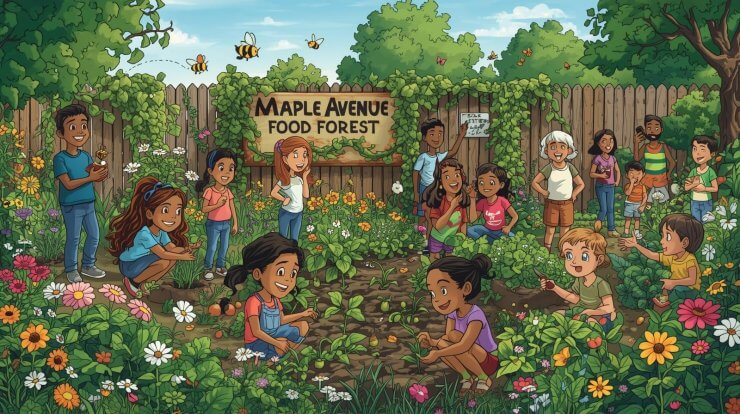
The empty lot on the corner of Maple Avenue had long been an eyesore. A sagging chain-link fence, tangled with vines, encircled the cracked asphalt, radiating heat on Summer afternoons. But where others saw decay, Clara Rivera saw potential—a chance to transform not only the land but the community itself.
At the town library, Clara addressed a gathering of sceptical neighbours. Though her voice trembled, her message was unwavering.
“We’re not just planting a garden,” she began. “We’re building a food forest—a space that will produce fresh food, cool the Summer heat, and bring us together as a community.”
Dan, a retired mechanic, raised an eyebrow. “Sounds like a lot of work. And money. Who’s footing the bill?”
Clara smiled. “We are. Together. The city is giving us a three-year lease, and we’ll fundraise, apply for grants, and partner with local businesses. It’s not just about money; it’s about putting our hearts into something that benefits us all.”
The room buzzed with whispers. Scepticism lingered, but curiosity and hope began to take root.
Building the Roots
The transformation began with clean-up. Decades of neglect had left the lot compacted, toxic, and strewn with debris. Volunteers arrived with shovels, gloves, and determination. Among them were Tanya and her two young children, their laughter cutting through the clang of metal and the crunch of broken glass.
Dan grumbled as he unearthed a rusted pipe. “This isn’t a garden. It’s a landfill.”
Clara wiped sweat from her brow. “Maybe now. But soon, it’ll be a forest.”
Slowly, hope replaced frustration. Compost enriched the soil, cover crops like clover and rye healed it, and mushrooms detoxified it. When Tanya’s daughter spotted a robin in the cleared area, she shouted, “Mom, look! The birds are coming back!”
The first plantings included nitrogen-fixing trees, shrubs, and wildflowers to attract pollinators. Dew sparkled on the grass, and the air smelled of promise. The community’s vision was beginning to bloom.
Interconnections and Innovations
The food forest flourished, drawing pollinators and native birds. Rain gardens prevented flooding, and shade trees cooled the area. Mrs. Patel, the corner store owner, marvelled at the changes. “My grandson’s asthma has improved,” she said. “The air is so much cleaner now.”
The project became a hub of learning and connection. Weekly “Grow and Share” days invited neighbours to plant, harvest, and share meals. Workshops on canning, composting, and herbal medicine turned the lot into an open-air classroom. Tanya’s children, once picky eaters, delighted in the fresh produce. “I’ve never seen them so happy eating vegetables!” she laughed.
Economic sustainability blossomed alongside the forest. A pop-up farmers market sold surplus produce, while Clara’s permaculture workshops funded the project. Even Dan found purpose, repairing garden tools for a modest income. “It’s not just about fixing tools,” he said. “It’s about fixing the neighbourhood.”
A Thorn in the Forest
Midway through the project, a developer proposed turning the lot into luxury condominiums. City council members were tempted by the promise of tax revenue and jobs.
“They want to rip it all up,” Clara told the community at an emergency meeting. Her voice shook, but her words were steady. “This isn’t just land. It’s our home, our health, our future.”
The community mobilized. Tanya started a petition; Dan offered to speak at the council meeting. Mrs. Patel collected signatures in her store. Children created artwork depicting the forest and presented it to the council.
At the hearing, Clara spoke passionately. “This forest isn’t just plants. It’s people. It cools our streets, feeds our families, and teaches our kids. Reducing it to ashes for dollars would destroy something priceless.”
Her words swayed the council. The lease was extended, and the food forest was granted protected status.
A Flourishing Future
Years later, the food forest stood as a testament to resilience and cooperation. Pollinators buzzed among blooming elderberries and peaches. Tanya’s children taught newcomers how to plant seeds. Dan, hands oily from fixing a wheelbarrow, was content. Mrs. Patel gave away jars of elderberry syrup, her pride in the community unmistakable.
“We didn’t just plant trees,” Clara reflected under the shade of a peach tree. “We grew a community.”
Tanya smiled, tears in her eyes. “And we’re just getting started.”
The lot on Maple Avenue had transformed not only its landscape but the lives of those who nurtured it. It wasn’t just a food forest—it was a symbol of hope and unity. ❖
About the Author: Faiza Api is an avid gardener and storyteller, weaving tales of nature’s beauty and the simple joys of life.




This is wonderful and beautifully written!
Here I go now…at the end of my road is a lot that has lain fallow for many years. I’d ride my horse around on it for a bit but it really wasn’t big enough other than to train her for some small thing or another. My true feelings always came out though, when I kept saying to myself, what a wonderful community garden this would make. I have true guilt feelings now because of what I could have done back then, like to round up my neighbors who have tractors, tillers or even enough lumber for raised beds. I should have done something about it when I was still able to. Please folks who love to garden and share, don’t let this be you! Be bold, I was and still am, but anyway, get out there meet and greet your neighbors and find out who would be interested in making a community garden. There would be families who honest to gosh darn could use the extra produce. Even egg laying hens could have coops there as well. It’s too late for me now who can barely walk around but it may not be for you. The lot at the end of my road is still bare and oh what it could be producing. I guess I can truthfully say, shame on me for not trying all those many years ago!