

 Give a Gift
 Previous
Read by Michael Flamel
A Taste of Tuscany
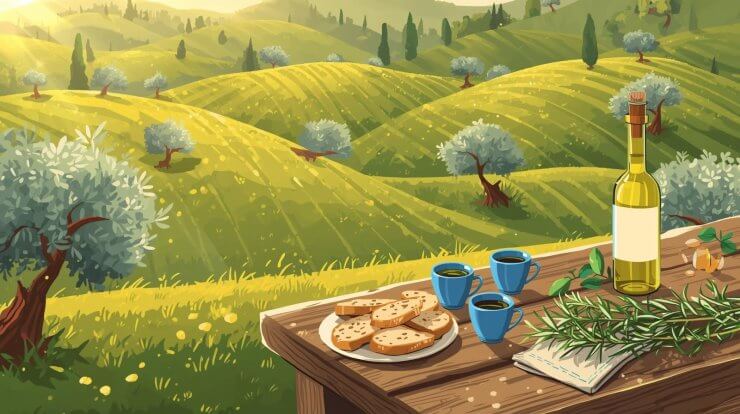
Gail and I had the pleasure of going to an olive-oil tasting on a recent trip to Tuscany, and let me tell you—what we thought we knew about olive oil barely scratched the surface. Our guide welcomed us with rows of cobalt-blue cups (Apparently, blue glass keeps you from judging oil by color alone.) and coached us through the ritual: warming the cup in our hands, inhaling the grassy aroma, taking a sharp sip, and letting the peppery notes bloom at the back of the throat.
We learned how professional tasters judge whether an olive oil is truly extra-virgin—it must be cold-pressed, unrefined, and below a specific acidity level—and how oils change as they age over time, mellowing in sharpness but losing some of their bright green flavors. By the end of the session, we were swirling and slurping like pros, discovering layers of artichoke, tomato leaf, and even hints of almond in the oils.
The Ancient Roots of Liquid Gold
Olive oil’s story stretches back more than 6,000 years to the rocky hills of the eastern Mediterranean. Archaeologists have found olive pits in clay jars from Bronze-Age Crete, and Homer famously called olive oil “liquid gold.” The Romans carried olives and their precious oil throughout their empire, building stone mills that still stand in parts of Italy today.
In Italy—and especially Tuscany—olive oil has been central to cuisine and culture for centuries. Medieval farmsteads often built their kitchens around the olive press. Families still harvest their groves by hand each Autumn, rushing olives to the mill within hours to ensure that emerald-green freshness in every bottle.
Fun Facts About Olive Oil
- Olive trees can live for hundreds—even thousands—of years. Some trees in the Mediterranean are believed to be over 2,000 years old and still bear fruit.
- Olive trees can be grown in the United States: California, Arizona, Texas, and even parts of Georgia and the Carolinas support olive groves thanks to their warm, dry Summers and mild Winters.
- Different olive varieties produce unique flavors: Frantoio and Leccino (Tuscan classics) make aromatic, peppery oils; Arbequina (popular in Spain and California) is buttery and mild; Koroneiki (from Greece) is robust and fruity.
Storing and Savoring
Good olive oil is fresh produce, not pantry decoration. Store it in a dark glass bottle, keep it in a cool, dark cupboard—not next to the stove—and use it within 12 to 18 months of pressing for the best flavor.
Other countries, including Spain, Greece, Portugal, Tunisia, and Morocco, are also leading producers of superb oils. If you see the harvest date on the label, choose the freshest bottle you can find.
Olive Oil the Tuscan Way
In Tuscany, olive oil isn’t just for salads—it’s for nearly everything. Locals drizzle it over grilled bread for bruschetta, stir it into soups, spoon it over Bistecca alla Fiorentina (Tuscan steak), finish roasted vegetables, and even use it to moisten slow-cooked wild boar ragù. Gail and I quickly realized that in Tuscany, olive oil is treated less like a condiment and more like the heartbeat of the meal.
A Final Drizzle
Gail and I came home inspired—and with a few carefully packed bottles in our suitcase. Now we’d love to hear from you: What’s your favorite olive oil—local or imported—and how do you use it in your cooking?
Explore our Amazon Olive Oil Buyer’s Guide here where Gail and I share some of our favorite bottles you can easily find in the U.S. ❖