

 Give a Gift
 Previous

Read by Michael Flamel
I’ve read more self-help books than I care to admit. Some were helpful, some were forgettable, and a few were written with such certainty that I half expected the author to knock on my door and check my progress. But long before happiness became a college course—or a podcast category—I stumbled into a truth that has never failed me:
Food gardening makes me happy.
Not every day. Not every season. And certainly not every tomato plant.
Food gardening, as anyone who has ever tried it knows, is gloriously complicated. It begins with optimism—planning, seed catalogs, dreams of abundance—and quickly introduces humility. Seeds don’t germinate. Seedlings flop. Weather refuses to cooperate. Pests show up uninvited. Harvests can be breathtaking… or nonexistent.
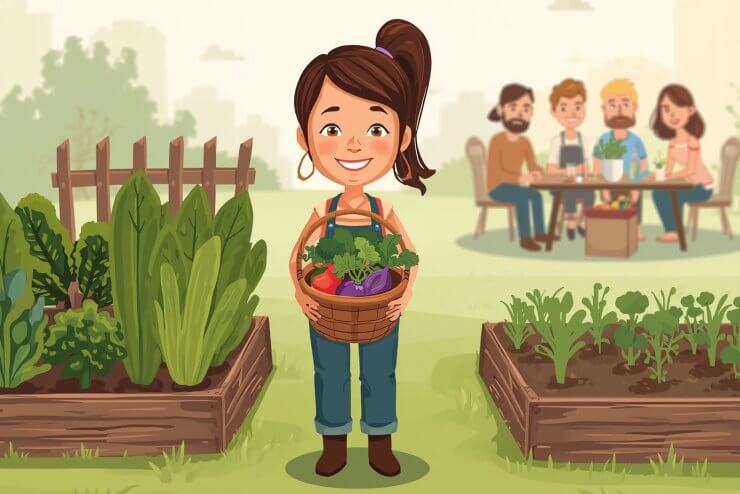
And yet, somehow, both the triumphs and the disappointments have added up to a life that feels richer, calmer, and more grounded.
That paradox—the idea that failure can still lead to happiness—is where the science of happiness and the practice of food gardening shake hands.
The Science Behind Dirty Hands and Happy Hearts
Modern psychology tells us that happiness isn’t a permanent state. It’s not something you “achieve” and check off a list. Researchers studying happiness consistently point to a handful of factors that matter most:
- Purpose
- Connection
- Mastery
- Mindfulness
- Gratitude
If that sounds familiar to gardeners, it should.
Food gardening quietly checks every one of those boxes.
When I plan a garden, I’m engaging in purposeful thinking. When I plant, I’m hopeful. When I tend, I’m attentive. When I harvest—or fail—I’m learning. And when I cook and share what I’ve grown, I’m connected to something larger than myself.
That cycle repeats itself year after year, embedding happiness not in outcomes, but in participation.
Lessons Learned at My Father’s Elbow
Some of my earliest lessons in happiness came from my father, a professional chef who deeply believed in food as both nourishment and joy. He never guaranteed success in the garden—quite the opposite. He taught me that food gardening was an act of faith mixed with patience.
When something failed, he didn’t scold the soil or curse the seeds. He shrugged, adapted, and moved on to the stove. Beans replaced meat. Herbs elevated humble vegetables. Meals were never diminished by the garden’s missteps.
What I learned, long before psychologists put language around it, was this:
Happiness isn’t about control. It’s about response.
Gardening gives us endless opportunities to practice that lesson together.
Gail, the Kitchen, and the Shared Harvest
Years later, that same rhythm plays out in my life with my wife, Gail. Some of our happiest moments aren’t tied to record harvests, but to simple rituals: walking the garden together, deciding what’s ready, improvising dinner based on what the plants are willing to give us that day.
Food gardening turns cooking into collaboration—not just with each other, but with the season itself.
When a crop thrives, we celebrate. When it disappoints, we adapt. Either way, we eat well, laugh often, and feel deeply connected to the process.
A Step-by-Step Path to Becoming a Happier Food Gardener
After years of digging, cooking, failing, succeeding, and reflecting, I’ve distilled a few principles that can help gardening lead to happiness—regardless of results.
- Redefine Success
Success isn’t yield alone. It’s learning, noticing, tasting, and trying again. A failed crop still teaches you something valuable.
- Garden at Your Own Scale
Overcommitting is a fast track to frustration. Grow what fits your life, not someone else’s garden photos.
- Expect Imperfection
Plants are living things, not appliances. Once you accept unpredictability, disappointment loses its sting.
- Cook What You Grow—Even a Little
Happiness multiplies when a single herb or tomato becomes part of a shared meal.
- Share the Story
Gardening is richer when it’s communal—whether that’s swapping produce, advice, or good-natured complaints with friends.
- Stay Curious
Curiosity transforms setbacks into experiments. Every season becomes a chapter, not a verdict.
Why Even Failure Feels Good
One of the most surprising findings in happiness research is that effort itself creates satisfaction, even when outcomes fall short. Gardening embodies this perfectly.
When a plant fails, I’m disappointed—but I’m never empty. I’ve still spent time outdoors. I’ve still paid attention. I’ve still participated in something real.
That, it turns out, is happiness with dirt under its fingernails.
Final Thoughts from the Garden Path
Food gardening doesn’t promise constant joy. What it offers instead is something better: a meaningful process that makes room for joy, disappointment, connection, and growth—all at once.
And maybe that’s why it works so well. Happiness isn’t about avoiding failure. It’s about finding value in the doing. ❖